


In today’s rapidly evolving retail landscape, staying ahead of the competition is more crucial than ever. But how do retailers make informed decisions amid a sea of data? The answer lies in retail business intelligence (BI). This tech-driven approach transforms raw data into meaningful insights, allowing businesses to optimize operations and enhance customer experiences.
“Retail business intelligence acts as a compass, guiding retailers through the complexities of modern commerce, ensuring they not only survive but thrive.”
In this article, we’ll unravel the intricacies of retail BI, exploring its definitions, applications, and the substantial benefits it brings to your business. Whether you’re a small boutique owner or managing a sprawling retail chain, the insights provided by BI can redefine your approach to selling. Ready to dive deeper into this transformative world? Let’s explore together.
What is retail business intelligence?
Retail business intelligence, often abbreviated as BI, is the process where data is transformed into actionable insights specifically for the retail sector. Utilizing data from various aspects of your operations—like sales, inventory, customer behavior, and market trends—retail BI empowers you to make informed decisions that drive growth and efficiency for retail analytics.
The focus is on gathering, storing, analyzing, and visualizing data relevant to retail activities. With powerful analytics and reports, you can identify patterns, forecast trends, and pinpoint opportunities and challenges in your business environment.
One key aspect of retail BI is its ability to provide a comprehensive overview of how your business is performing. You gain insights not just into what is happening internally but also how your business measures up against industry trends and competitors. This holistic view is essential for strategic planning and staying ahead in a competitive market.
Retail business intelligence use cases
Imagine effortlessly uncovering shopping trends, optimizing your inventory, and delivering personalized customer experiences—all while keeping an eye on the competition. That’s the magic of retail business intelligence at work! Retail BI empowers you to harness data like never before, translating numbers into actionable insights. In this section, we’re diving deep into how diverse retailers are leveraging these capabilities to gain a competitive edge in the ever-evolving market landscape.
The main use cases of retail BI are inventory management, customer segmentation, sales forecasting, and performance analysis.
Inventory management
One of the primary use cases is inventory management. With accurate data analytics, you can maintain optimal stock levels, reducing both overstock and stockouts. This helps in making data-driven purchase decisions and foreseeing demand trends.
Customer Segmentation
Furthermore, retail BI is essential in customer segmentation. By analyzing purchasing habits and preferences, you can create highly targeted marketing campaigns. This leads to enhanced customer satisfaction and increased loyalty, ultimately driving revenue growth.
Sales forecasting
Another significant application involves sales forecasting. With the ability to predict sales trends based on historical data, you’ll be better equipped to strategize for peak seasons or new product launches, positioning your retail business for success.
Store Performance Analysis
Additionally, retail BI tools aid in performance analysis of different stores or departments. This provides a clear picture of what areas are thriving and which might require improvement, allowing you to allocate resources more effectively.
Key benefits of retail business intelligence
Retail business intelligence offers an array of benefits that can transform the way your business operates. By tapping into this powerful tool, you can unlock actionable insights that drive informed decisions, sharpen your competitive edge, and enhance overall efficiency.
The key benefits of retail business intelligence are enhanced decision-making, improved operational effiency, increased customer satisfaction, and boosted profit margins.
Enhanced Decision-Making
One of the standout benefits is the ability to make data-driven decisions. Armed with accurate, up-to-date information, you can quickly gauge the direction in which to steer your strategic initiatives. Whether it’s deciding on which product lines to expand or identifying underperforming stores, retail BI provides a solid foundation for decisions that lead to tangible results.
Improved Operational Efficiency
Retail BI streamlines operations by automating processes and providing real-time insights. This means your team spends less time on mundane tasks like manually crunching numbers and more time on strategic activities that move the needle. Consequently, efficiency is optimized across all levels of your retail operations.
Increased Customer Satisfaction
Understanding your customers better with BI-driven insights allows you to tailor your product offerings and marketing strategies to meet their needs. Enhanced customer segmentation and predictive analytics mean you can offer personalized experiences that improve satisfaction and foster loyalty.
Boosted Profit Margins
With the ability to optimize pricing, manage inventory more effectively, and understand trends, retail BI can significantly boost your profit margins. By minimizing waste and maximizing sales opportunities, your bottom line can improve admirably.
In essence, retail business intelligence doesn’t just keep you afloat in a competitive marketplace—it places you firmly at the helm with real-time insights and strategic foresight that pave the way for sustainable growth and innovative success.
Tools And Platforms For Retail BI
To effectively harness the power of retail business intelligence, platforms must seamlessly integrate retail-specific software. This integration allows for data importation, CPG analysis, and the communication of insights throughout the organization.
Moreover, the choice of platform can significantly impact the ease and effectiveness with which you leverage this data. Consider factors like user-friendliness, scalability, and customization options. It’s important to select a platform that not only meets your immediate needs but also grows with your business.
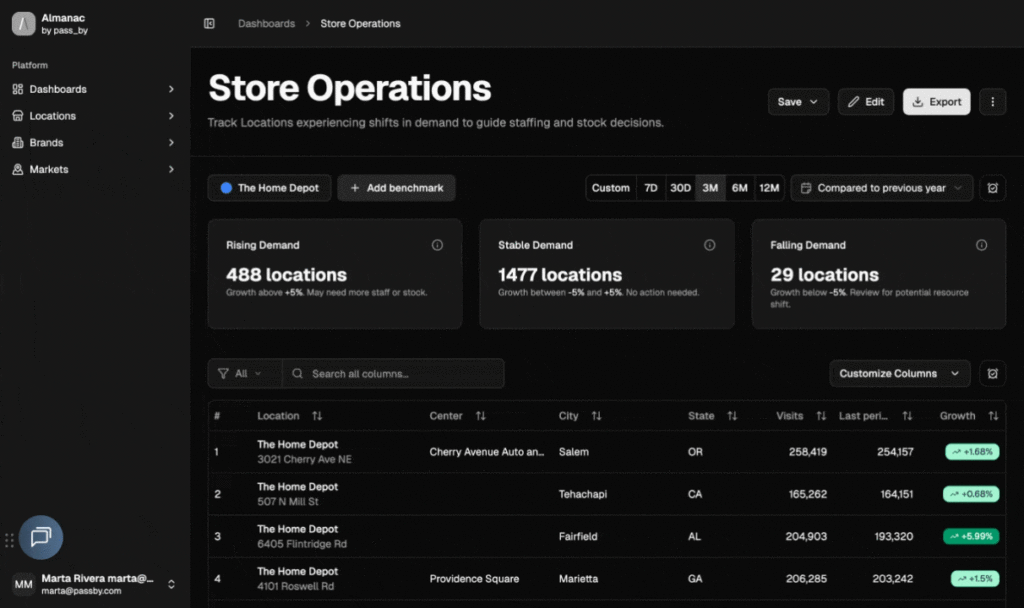
Platforms like PassBy offer robust features specifically designed for the retail sector. These tools provide a comprehensive view of consumer behavior, inventory levels, and sales trends, allowing you to derive actionable insights easily.
Equally important is the ability of the platform to integrate with existing systems. Seamless integration reduces the time and effort required to synchronize data, thus enhancing real-time decision-making capabilities. Look for platforms that support API connections and offer compatibility with other retail software you are already using.
Remember, the goal is to transform raw data into meaningful insights that drive strategic decision-making across all levels of your organization. By choosing the right tools, you pave the way for a more informed and agile business approach. As you delve deeper into retail BI, you’ll realize the profound impact it can have on every facet of your business, from the supply chain to customer experience.
PassBy
Retail business intelligence through PassBy offers unparalleled insights for US retailers, leveraging Almanac, a self-serve platform. This platform enables store operations, real estate, and marketing teams to access a comprehensive overview of brand performance, market movements, and competitive positioning.
Unique Advantage: PassBy stands out with the market’s most transparent accuracy validation. It achieves a 94% correlation to ground truth by corroborating data against hundreds of thousands of in-store sensors and sales records from over 15 independent data sources. In contrast, many competitors either withhold their validation processes or rely on less diverse sources.
Beyond mere visit counts, PassBy includes over $1 trillion in consumer spend data, correlated with foot traffic, allowing teams to determine if traffic results in actual sales. The 90-day predictive feed, crafted with Stanford’s NeuralProphet team, offers forward-looking visit predictions, empowering proactive planning over mere reactive analysis.
PassBy excels in flexibility. In addition to the Almanac platform and typical API/cloud options, it integrates with AI tools like ChatGPT, Microsoft Copilot, and Google Gemini, enabling teams to interact with market intelligence innovatively and seamlessly within their workflow.
Pricing: Offers three tiers—Essential, Premium, Ultimate—with a Test & Learn option providing 90 days of Almanac access for platform evaluation. Explore pricing options →
Ideal For: Retail teams seeking validated and precise US foot traffic and expenditure insights through a user-friendly platform, predictive analytics, and adaptable data delivery methods.
Retail business intelligence tool checklist
- Intuitive Interface: Ensure the tool offers an easy-to-navigate interface. A user-friendly platform saves time and reduces the learning curve for your team.
- Data Integration Capabilities: The ability to integrate seamlessly with various data sources, such as POS systems, CRM software, and online platforms, is crucial for comprehensive insights.
- Real-Time Analytics: Opt for tools that provide real-time data analytics. This feature allows you to make timely decisions and swiftly adapt to market changes.
- Customizable Dashboards: Look for platforms that allow you to create customizable dashboards. Tailored views offer can insights unique tailored to your specific business needs.
- Advanced Reporting: Comprehensive reporting features are essential. The ability to generate detailed reports helps in tracking performance and identifying areas for improvement.
- Scalability: Choose a BI tool that can grow with your business. Scalability ensures the tool can handle increased data volume as your business expands.
- Security Features: Ensure that the tool has robust security measures in place. Protecting sensitive business data is paramount in today’s digital landscape.
- Customer Support: Reliable customer support is important for addressing any issues or queries promptly. Look for platforms that offer robust support channels.
Let’s see how many we can cross off your list. Book a 15-minute walkthrough →.
Retail BI FAQs
What are the challenges in implementing retail business intelligence?
1) Integrating disparate data sources from various systems can be complex and time-consuming.
2) Ensuring data quality and accuracy is crucial, as incorrect data can cause significant losses.
4) Data privacy and security are paramount due to regulations such as GDPR.
User adoption can be challenging; comprehensive training is crucial to overcome resistance.
5) Scalability is necessary for handling increased data loads as the business grows.
6) The cost of implementing a BI system must be weighed against potential long-term returns.
What is the difference between retail BI and traditional data analysis?
Retail Business Intelligence (BI) and traditional data analysis both aim to harness the power of data, yet distinctively differ in their approach, focus, and application.
Retail BI is designed specifically for the retail sector, offering tools and solutions tailored around the nuances and complexities of retail operations. It leverages real-time data, often sourced from various retail-specific channels such as point of sale (POS) systems, customer loyalty programs, and supply chain logistics. With a focus on actionable insights, retail BI provides a holistic view to drive strategic decisions and streamline operations.
Meanwhile, traditional data analysis encompasses a broader scope, often applied across diverse industries. It tends to focus more on historical data, identifying patterns, and trends that require in-depth, manual interpretation. The analysis is frequently performed using spreadsheets or generic data tools, which may not address the unique demands of the retail environment directly.
Therefore, while both aim to extract value from data, retail BI stands out with its sector-specific insights, intuitive tools, and emphasis on real-time data application. It enables retailers to quickly adapt to market changes, optimize inventory, and enhance customer experiences, often leaving the granular manual analysis of traditional methods behind.
What are the privacy concerns associated with retail business intelligence?
When implementing retail business intelligence, privacy concerns are a significant consideration. Retail BI involves the collection and analysis of vast amounts of customer data, which can raise several ethical and privacy-related issues. Privacy concerns associated with retail BI include:
1) Data Collection: Retailers gather information through various channels, including loyalty programs, purchase histories, and online interactions. It’s crucial to ensure the data collected is relevant and necessary for the intended analysis while respecting customer privacy.
2) Consent and Transparency: Obtaining explicit consent from customers about what data is collected and how it will be used is vital. Retailers should provide clear, accessible privacy policies and ensure transparency in their data practices.
3) Data Security: Protecting customer data from unauthorized access and breaches is critical. Retailers must implement robust security measures to safeguard sensitive information and maintain customer trust.
4) Data Usage: Ethical concerns arise around how customer data is used. Retailers need to avoid overly intrusive analysis that might lead to discomfort among customers. Personal data should be used to genuinely enhance customer experience and store performance without crossing privacy boundaries.
By addressing these privacy concerns, retailers can effectively leverage business intelligence while fostering trust and maintaining ethical standards.
What is another name for retail business intelligence?
Retail business intelligence is often shortened to retail BI or simply BI. It may also be referred to as a decision support system.
What is a retail intelligence platform?
A retail intelligence platform is a tool, either software or an online portal, that works to support retail companies in collecting, tracking, cleaning, processing, analyzing, and visualizing data. These platforms can offer further insights into the data, trends, and consumer behavior through highly-trained machine learning (ML) models.
How can AI improve retail?
In retail business intelligence, AI can be used for predictive analytics. The AI takes a large data set, such as the past five years of a store’s past performance, and can then output predictions on future performance. Predictive analytics of up to 3 months for retail is available from Almanac by pass_by, a reporting tool that offers unprecedented insight.
How do companies use business intelligence?
Companies use business intelligence (BI) tools and platforms to build strategies, support decision-making, and present data. Companies use BI to create trend analysis, identify competitors, and analyze past performance.