


In today’s fast-paced retail environment, staying ahead of the competition demands more than just a keen eye for trends. It requires a keen eye on data—data that’s transformed by retail analytics into actionable insights that can significantly boost sales and customer satisfaction. But what exactly is retail analytics, and why does it matter?
Whether you’re looking to streamline operations or enhance customer interaction, retail analytics delivers the tools you need to navigate the complex world of retail. Let’s explore how embracing this innovative approach can transform your business for the better.
What is retail analytics?
Retail analytics is an essential component in the modern retail environment. It refers to the use of retail business intelligence techniques and tools specifically designed for understanding and improving various aspects of retail business performance. Picture this: you have a treasure trove of valuable insights hidden within your sales figures, customer behavior, and inventory data. Retail analytics helps you unlock these insights, transforming them into strategic decisions that can elevate your business to new heights.
By gathering and scrutinizing data on aspects like customer preferences, shopping patterns, and product movement, you can make informed choices about marketing strategies, inventory management, and customer service improvements. Think of retail analytics as your pathway to not just meeting but exceeding consumer expectations. It’s a means to not only streamline your operations but also create personalized experiences that foster customer loyalty and result in increased revenue.
Retail analytics tools and providers
When it comes to retail analytics tools and providers, there’s a spectrum of solutions available tailored to different needs and scales. These tools range from comprehensive platforms that handle everything from data collection to advanced analytics, to specialized providers that focus on particular aspects of retail operations. Let’s delve into some prominent tools and providers in the retail analytics landscape.
| Provider | Accuracy | Accessibility | US coverage | Pricing |
| PassBy: best for market and customer journey analysis | 94% correlation to ground truth, validated against in-store sensors + sales data, 15+ data inputs | Almanac platform, API, cloud delivery (Snowflake, AWS, GCP), AI assistant integrations (ChatGPT, Copilot, Gemini) | 1.5m+ store locations, 1m+ trade areas | 3 tiers: Essential, Premium, Ultimate. Test & Learn (90-day trial) available. See pricing → |
| RetailNext: Best for in-store analysis | Aurora sensors provide accurate in-store traffic counting | API included to embed data into your internal workflows | Tracking over 560 retailers across 100+ countries | Tailored pricing system: receive a quote |
| Placer: Best for broad use cases | Undisclosed methodology. Limits data for locations with fewer than 50 unique devices | Platform (UI), API add-on, data marketplace | Wide US coverage across retail, CRE, dining, entertainment | Custom annual contracts. Freemium tier available with limited access. Estimated $12k-$50k/year for paid plans |
The choice of tool or provider largely depends on your business goals, the complexity of your data needs, and your budget. Retail analytics tools are essential for turning raw data into actionable insights, allowing businesses to optimize operations, improve customer experiences, and ultimately drive growth.
PassBy: Retail Analytics Provider
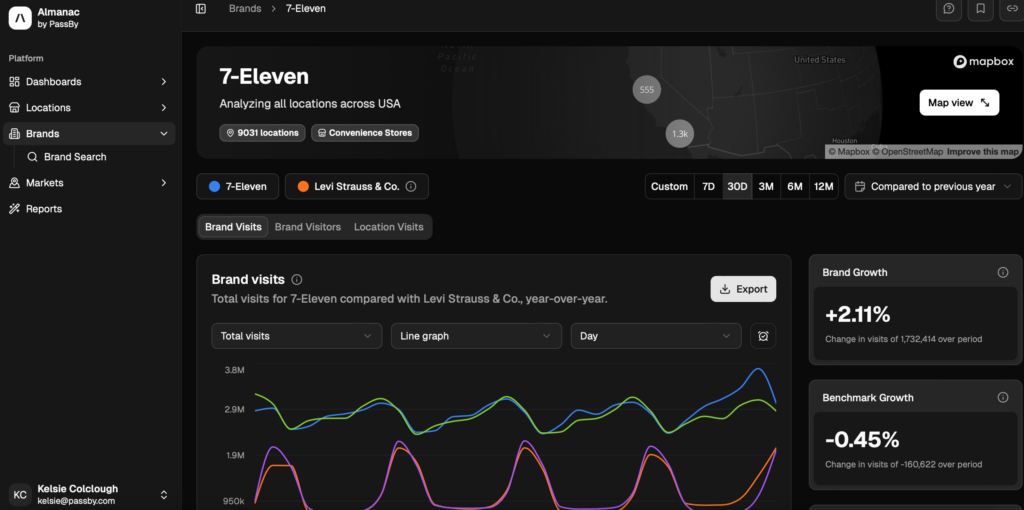
PassBy features Almanac, a retail analytics platform designed to deliver in-depth insights into US retail locations and markets, directly in your browser. With Almanac, your teams gain data-driven context for stores and markets, empowering cross-functional collaboration based on uniform, analytical facts.
Why choose PassBy?
Works reliably in dense urban areas and malls
Trusted by 100+ retailers for Store Operations, Marketing, Real Estate, and Strategy teams alike.
Covers 1.5m+ store locations, 1m+ trade areas, 50 billion visits modelled, $1 tn spend indexed
How much does PassBy cost?
Prices vary for customer needs and custom packages, but PassBy offers an Essential, Premium, and Ultimate plan to suit all budgets and team needs.
To talk more about what plan would be best for you and your team, book a call to get a demo.
Why is retail analytics important?
Retail analytics serves as a pivotal component for retailers seeking to thrive in today’s fast-paced market environment. With actionable insights derived from data, businesses can sharpen their strategies and stay ahead of competition by accurately predicting consumer trends and preferences. By doing so, you not only cater to customer demands but also enhance customer loyalty, translating to increased profitability.
Informed decision-making is crucial in the retail sector, and analytics provides the backbone for those decisions. Leveraging data allows you to fine-tune everything from inventory management to promotion strategies, ensuring resources are utilized effectively. As a result, you can reduce waste, lower costs, and optimize supply chain efficiencies.
The integration of analytics empowers retailers to navigate disruptions and adapt to changes swiftly. This adaptability is essential in maintaining a competitive edge and driving long-term business growth. By investing in the right analytics tools, you can transform how your retail business functions, focusing on meeting consumer demands with precision and foresight.
Benefits of retail analytics
Retail analytics is more than just a tool—it’s a transformative force reshaping the way retailers understand and serve their customers. The benefits of retail analytics for businesses are:
- Improved decision-making and strategic planning: Retail analytics empowers you to make informed decisions based on data-driven insights rather than just intuition. By analyzing sales data, customer feedback, and market trends, you’ll be able to strategically plan your business moves with confidence.
- Enhanced inventory management: Say goodbye to overstock and stockouts. With retail analytics, you can optimize your inventory levels by accurately forecasting demand and automating reorder processes to ensure you always have the right products at the right time.
- Personalized customer experiences: Knowing your customers is key. Retail analytics helps you analyze customer behavior, preferences, and feedback, allowing you to tailor experiences and offerings that resonate on an individual level, thereby boosting loyalty and satisfaction.
- Optimized pricing strategies: Retail analytics lets you monitor competitor pricing, understand market demand, and determine the best price points for your products—ensuring that your pricing strategy maximizes both profit margins and sales volume.
- Increased operational efficiency: Streamlining operations can significantly affect your bottom line. By using analytics to identify inefficiencies and potential improvements, you’ll be able to enhance productivity, reduce waste, and save time across your business processes.
- Refined marketing campaigns for better targeting: Gain a deeper understanding of customer demographics, preferences, and behaviors with analytics. This knowledge allows you to create precise marketing campaigns that reach the right audience, leading to higher conversion rates and ROI.
- Improved supply chain resilience: Analytics play a crucial role in predicting supply chain disruptions and identifying optimization opportunities. By proactively addressing challenges, you can ensure a more resilient and responsive supply chain.
- Competitive advantage in a dynamic market: Stand out from the competition by leveraging analytics to respond quickly to market changes, adapt strategies, and innovate—keeping your business agile and relevant in an ever-evolving retail landscape.
- Better staff scheduling and resource allocation: Analytics can forecast peak hours and customer flow patterns, allowing you to effectively schedule staff and allocate resources to improve employee productivity and customer service.
- Significant boosts in sales and profitability: Ultimately, all these benefits contribute to a healthier bottom line. By improving efficiency, enhancing customer experiences, and optimizing strategies, retail analytics can drive up your sales and profitability significantly.
Examples of retail analytics
Ever wondered how some stores seem to know exactly what’s on your wishlist before you do? That’s the magic of retail analytics. Using analytics, retailers can unearth gems of insight that forecast trends, enhance customer journeys, and fine-tune inventory management. Some examples of retail analytics include CPG analytics, sales analysis, customer analysis, and inventory analytics.
- CPG Analytics: Similar to retail analytics, CPG (Consumer Packaged Goods) analytics provides key insights into consumer preferences and product performance. It assists brands in identifying trends and patterns that can drive marketing and production strategies.
- Sales Analysis: Understanding sales patterns and performance across different products, departments, and locations.
- Customer Analysis: Analyzing customer demographics, preferences, and shopping behavior to tailor services and products.
- Inventory Analysis: Monitoring stock levels and turnover rates to optimize inventory management and reduce wastage.
- Marketing Analysis: Evaluating the success of marketing campaigns and understanding the return on investment for promotional activities.
- Pricing Analysis: Assessing and adjusting pricing strategies to stay competitive while maximizing profit margins.
- Supplier Analysis: Analyzing supplier performance to ensure timely deliveries and maintain high-quality standards.
- Operational Analysis: Identifying inefficiencies in operations and logistics to streamline processes and reduce costs.
Retail analytics best practices
Now that you’re aware of the importance of retail analytics, here are some best practices that will help you leverage its power effectively:
- Define Clear Objectives: Start by identifying what you aim to achieve with retail analytics. Is it to enhance customer experience, optimize inventory, or boost sales? A clear set of objectives will guide your analytics journey.
- Embrace Data Integration: Ensure your analytics tools can seamlessly integrate with various data sources. By consolidating data from inventory, customer feedback, sales channels, and social media, you’ll gain a more comprehensive view.
- Focus on Data Quality: Reliable insights stem from high-quality data. Regularly clean and validate your datasets to avoid inaccuracies and ensure actionable results.
- Utilize Advanced Analytics: Leverage advanced analytical tools and technologies such as AI and machine learning. These can provide deeper insights and predictive capabilities that traditional analytics might miss.
- Engage in Continuous Learning: The world of retail analytics is ever-evolving. Stay updated with the latest tools and trends, and continuously educate your team to stay ahead.
- User-Friendly Tools: Choose analytics platforms that are user-friendly, ensuring that all relevant stakeholders can access and interpret the data without needing extensive technical know-how.
- Monitor and Adjust: Retail is a dynamic environment. Regularly monitor your analytics outcomes and be ready to adjust strategies to respond to changes in customer behavior and market trends effectively.
Adopting these best practices will foster a data-driven culture in your retail business, enabling strategic decisions that help maximize profitability and customer satisfaction.
How to implement retail analytics
Implementing retail analytics is a strategic endeavor that, when executed well, can significantly boost your retail operations.
- To get started, it’s crucial to have a clear understanding of what you aim to achieve with analytics. Define specific goals such as increasing sales, improving customer retention, or optimizing inventory management. These objectives will guide your analytics efforts.
- Next, focus on data collection. Gather data from various sources such as point-of-sale systems, online transactions, customer feedback, and social media interactions. It’s essential that this data is accurate and relevant to your objectives. Utilizing data integration solutions can help combine these diverse foot traffic data sources, offering a more comprehensive view of your retail environment.
- Once your data is consolidated, the implementation of advanced analytics techniques becomes possible. Employ real-time analytics systems to obtain insights when they matter the most—during business hours. Leverage predictive analytics to forecast trends and customer behaviors, helping you stay ahead of the curve.
- It’s also vital to make data accessible and understandable to your team. Use data visualization tools to transform complex datasets into interactive, easy-to-digest visuals. This will enable your team to make informed decisions quickly.
- Finally, establish a cadence for regular data analysis and review. This proactive approach will ensure that insights translate into actionable strategies, keeping your business agile and responsive to changes in the market.
By following these steps, you can successfully implement retail analytics, paving the way for data-driven decisions that can improve your margins, reduce waste, and grow your revenue.
FAQs
What are the four stages of analytics?
The four stages of analytics represent a progressive approach to understanding and utilizing data within a retail environment. Each stage builds upon the previous one, incorporating more advanced analysis and providing deeper insights.
1) Descriptive Analytics: The first stage involves understanding what has happened in your retail operations. It involves the aggregation and interpretation of historical data to identify trends, patterns, and anomalies. Such analysis helps retailers understand past performance and sets the stage for future exploration.
2) Diagnostic Analytics: Moving beyond mere observation, diagnostic analytics seeks to understand why certain trends or patterns have occurred. By digging into the data, retailers can uncover the specific reasons behind past successes or failures, enabling them to make informed decisions on corrective actions or strategic shifts.
3) Predictive Analytics: This stage leverages statistical models and machine learning algorithms to forecast future trends based on historical data. Retailers can anticipate customer behavior, demand fluctuations, and market changes, allowing them to plan proactively and mitigate potential risks.
4) Prescriptive Analytics: As the most advanced stage, prescriptive analytics recommends actions that can drive better outcomes. By considering a variety of scenarios and their potential impacts, this stage offers actionable insights that help retailers optimize strategies, improve operational efficiency, and enhance overall performance.
In mastering these stages, retailers not only gain clarity on their past and present operations but also carve clear pathways to future growth and competitive advantage.
How is data analytics used in retail?
By using data analytics, retailers can forecast demand more accurately, manage their inventory efficiently, and provide personalized shopping experiences to customers. Data anlytics is used to gain customer insights, optimize inventory and price, improve a supply chain, and enhance the cusomer experience.
Customer Insights: Retailers leverage data analytics to gain deep insights into their customer’s preferences and buying habits. By analyzing past purchase data, retailers can identify trends and predict future buying behavior, which helps in tailoring marketing campaigns and offering personalized product recommendations.
Inventory Management: Effective use of data analytics allows retailers to optimize their inventory levels, reducing the risks of stockouts or overstocking. Predictive analytics tools assess past sales data alongside external factors like seasonality and market trends to ensure that retailers maintain an optimal supply of products.
Price Optimization: Retail analytics assists in setting the right price points for products. By examining competitive pricing data, consumer demand, and historical sales data, retailers can develop dynamic pricing strategies that maximize profitability while staying competitive.
Supply Chain Efficiency: Analytics helps streamline supply chain operations by predicting potential disruptions and identifying areas for improvement. Retailers can analyze logistics performance data to optimize delivery routes, reduce shipping times, and cut costs.
Enhanced Customer Experience: Data analytics is key in crafting a personalized shopping experience. Retailers use customer behavior data and feedback to improve their service offerings, tailor promotions, and create a seamless shopping experience across multiple channels.
Utilizing data analytics, retailers not only enhance operational efficiencies and customer satisfaction but also drive significant growth in sales and market positioning.