


Every guide on increasing foot traffic starts with the same advice: improve your window displays, host events, post on social media. Those tactics are not wrong, but they are incomplete. They treat foot traffic as a marketing problem when it is actually a multi-team challenge that spans store operations, real estate, and marketing.
The retailers who consistently grow foot traffic do not rely on a single tactic. They use data to diagnose why traffic is where it is, identify the specific lever that will move it, and measure whether the intervention worked. The strategy for a store with declining traffic in a growing trade area is completely different from the strategy for a store with strong traffic but poor conversion.
This guide covers 12 strategies for increasing foot traffic, organised by the team that owns each lever. Every strategy is grounded in what foot traffic data reveals, not generic advice.
Start with diagnosis, not tactics
Before applying any strategy, you need to know why traffic is at its current level. Foot traffic data answers this by revealing the context that a single store’s metrics cannot.
Is this a store problem or a market problem? If your traffic is declining but competitors in the same trade area are also declining, the problem is market-level (population shift, new competitor entry, macro consumer behaviour). If competitors are gaining traffic while yours falls, the problem is specific to your store.
Is this a traffic problem or a conversion problem? A store with declining sales but stable foot traffic does not need more visitors. It needs to convert more of the ones it already has. Increasing traffic to a store that cannot convert it wastes marketing budget.
Is the trade area changing? Visitor origin data shows whether your catchment is stable, expanding, or contracting. A store that historically drew visitors from a 15-minute drive radius but now only draws from 8 minutes may have lost ground to a new competitor that opened closer to part of your customer base.
Run this diagnosis before choosing which strategies to deploy. The data tells you which lever to pull.
[ Almanac showing a store’s competitive benchmarking or trade area view that illustrates the diagnostic step. Ideally showing one store vs competitors in the same market, or a trade area comparison between two time periods.]
Strategies for store operations teams
These levers are controlled by the people who run individual stores and store networks.
1. Align staffing and hours to actual traffic patterns
This is the most underrated foot traffic strategy because it is invisible to the customer when done right. Traffic data broken down by hour and day of week shows exactly when visitors arrive. Aligning your staff schedule and operating hours to those patterns ensures the store is ready when people show up.
The impact works both ways. Understaffing during peak periods means longer queues, less floor assistance, and a worse experience that discourages repeat visits. Overstaffing during quiet periods burns labour budget that could be redirected to marketing or store improvements.
Extending hours to capture visits that currently happen just before opening or after closing can add incremental traffic at minimal cost. Traffic data reveals whether this opportunity exists for each location individually, because the answer varies by store, by market, and by day of week.
2. Improve in-store conversion to justify further traffic investment
This strategy does not directly increase foot traffic, but it creates the economic case for investing in the strategies that do. A store converting 15% of its visitors into buyers will generate more return from a traffic-driving campaign than a store converting 8%.
Use foot traffic data alongside POS data to calculate conversion rate by location. Stores with low conversion relative to their traffic volume need operational improvements (layout, staffing, product availability, checkout speed) before they need more visitors.
Once conversion is strong, every incremental visitor the marketing team drives through the door generates revenue. Without that foundation, traffic growth is an expense with diminishing returns.
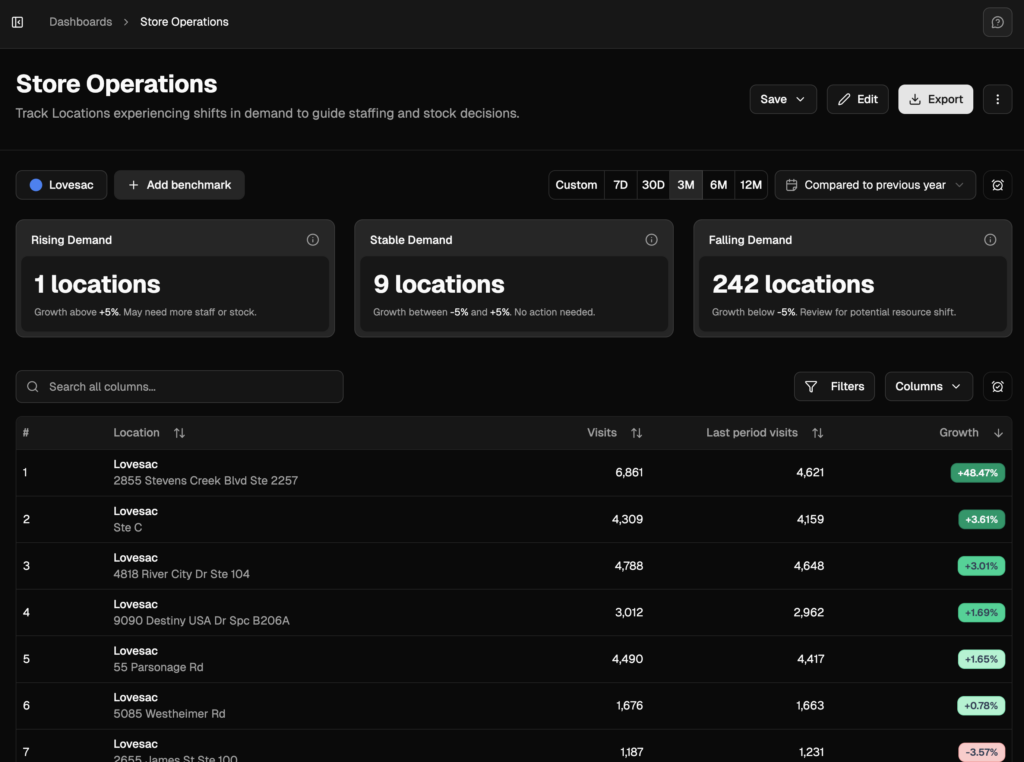
3. Benchmark against your own network to find templates for success
If you operate multiple locations, your best-performing stores contain the playbook for your underperformers. Foot traffic data lets you identify which stores are outperforming their market context (not just hitting the highest absolute numbers, but performing best relative to the competition in their trade area).
Study what those stores do differently: layout, staffing ratios, local marketing, community engagement, product mix. Then test those approaches at the underperforming locations. The data tells you which stores to learn from and which to fix.
Strategies for marketing teams
These levers are controlled by the teams responsible for driving awareness and visits.
4. Use foot traffic data to time promotions
Most promotional calendars are built around intuition, seasonal assumptions, or corporate schedules. Foot traffic data reveals the actual rhythm of each store’s traffic, and the gaps where a promotion could drive incremental visits.
If data shows a consistent midweek traffic dip on Tuesdays and Wednesdays, that is when a targeted promotion has the most room to lift visits without cannibalising existing peak-period traffic. Running a promotion on Saturday when the store is already at capacity generates noise but not incremental revenue.
The same logic applies to seasonal planning. If your holiday traffic peaked in the first week of December last year but your biggest promotional push landed in the third week, there is a timing mismatch that data can correct.
5. Measure campaign attribution with before/after traffic data
The most common reason marketing teams underinvest in foot-traffic-driving campaigns is that they cannot prove the campaigns work. Digital campaigns have clicks and conversions. Physical store campaigns traditionally have nothing.
Foot traffic data changes this. By comparing visit volumes during a campaign window against a baseline period, and controlling for seasonality and competitor trends, you can isolate the incremental visits a specific campaign generated. A local radio campaign that drove 400 incremental visits over two weeks, at a cost of $5 per incremental visit, is a number a CFO can evaluate.
This measurement capability unlocks budget. When marketing can prove that a campaign drove a measurable lift in physical visits, the case for repeating and scaling it becomes straightforward.
6. Profile your actual visitors and target accordingly
Many marketing teams target an assumed customer profile based on brand positioning or historical surveys. Foot traffic demographic data reveals who is actually walking through the door, which may differ from the assumed target.
If your visitor profile skews older and higher-income than your media plan targets, you are spending money reaching people who are not visiting. If weekend visitors have a different demographic profile than weekday visitors, the messaging and channels should differ for each.
Visitor psychographic data adds another layer: lifestyle interests, media consumption, and shopping behaviour. A store whose visitors index highly on outdoor recreation and fitness can partner with complementary local businesses, sponsor relevant community events, or run targeted digital campaigns to lookalike audiences, all grounded in observed behaviour rather than guesswork.
7. Invest in local SEO and Google Business Profile
This is well-covered by other guides, so the short version: 46% of Google searches have local intent, and a well-optimised Google Business Profile is the most cost-effective way to capture people who are already searching for a store like yours nearby.
The foot traffic data angle: use visitor origin data to understand how far people travel to reach your store. If your trade area extends 20 minutes in one direction but only 8 minutes in another, there may be an awareness gap in the shorter-reach direction that local SEO, targeted ads, or community presence could fill.
8. Run events that create a reason to visit
Events work, but only when they are designed around the traffic pattern rather than against it. A weekend event at a store that is already full on weekends adds congestion without incremental visits. A weeknight event at a store that is quiet after 6pm creates genuinely incremental traffic.
Foot traffic data tells you when you have capacity to fill. The event strategy follows from there: workshops, product launches, community gatherings, tastings, or partnerships with local businesses timed to fill specific gaps in the weekly traffic pattern.
Measure the impact by comparing event-day traffic to the same day in prior weeks. If a Tuesday evening event drove 180 visits when the typical Tuesday evening sees 60, the event generated 120 incremental visits. Track whether those visitors return in subsequent weeks to measure lasting impact beyond the event itself.
Strategies for real estate and portfolio teams
These levers affect foot traffic at a structural level, over longer time horizons.
9. Choose locations where traffic is already going
This is the highest-leverage foot traffic decision a retailer makes, and it happens before the store opens. Foot traffic data for candidate sites, combined with trade area analysis and competitive benchmarking, predicts what traffic level a new location can realistically achieve.
A site in a high-traffic corridor with strong demographic alignment will generate foot traffic from day one. A site in a location with declining traffic requires the store itself to be the draw, which is a much harder and more expensive proposition.
For more on data-driven site selection, see our guide to retail site selection.
10. Address cannibalisation before it erodes traffic
When two of your stores share a significant portion of their trade area, they compete with each other for the same visitors. Opening a new location too close to an existing one can decrease traffic at both stores while increasing costs.
Trade area overlap analysis shows how much cannibalisation risk exists between any pair of locations. If a new site would draw 35% of its traffic from the catchment of an existing store, the net traffic gain is much lower than the new site’s standalone projection suggests.
The same analysis applies in reverse: if you are considering closing a store, trade area data predicts where its traffic would migrate. If most visitors would go to another of your locations, the closure preserves your total traffic. If most would go to a competitor, the closure costs you customers permanently.
11. Evaluate co-tenancy and adjacency effects
Who you are next to matters. A coffee shop adjacent to a gym benefits from the gym’s morning traffic. An apparel store next to a strong department store anchor benefits from the anchor’s draw.
Foot traffic data reveals these adjacency effects by showing cross-visitation patterns: what other locations do your visitors go to on the same trip? Understanding these patterns helps real estate teams choose sites where the surrounding tenant mix creates natural traffic that benefits your store.
Strategies that span teams
12. Use predictive data to plan ahead, not react
Most foot traffic strategies are reactive: traffic dropped last month, so we need a promotion this month. Predictive foot traffic data reverses this by forecasting visit patterns 90 days ahead.
With forward-looking data, operations can pre-adjust staffing for predicted traffic levels. Marketing can time campaigns to coincide with predicted dips rather than responding after the dip has already occurred. Real estate can factor seasonal predictions into lease timing decisions.
PassBy provides 90-day predictive feeds built on AI models validated against ground truth data. This shifts the entire approach from reactive problem-solving to proactive planning.
See how Almanac helps teams across store ops, marketing, and real estate grow foot traffic with data. Book a 15-minute walkthrough →
FAQ
How can I increase foot traffic to my retail store? Start by diagnosing why traffic is at its current level: is it a market-level issue, a store-specific issue, or a conversion issue? Then choose the appropriate lever. Marketing campaigns drive awareness and visits. Operational improvements (staffing, hours, layout) improve the experience for existing visitors. Location decisions determine baseline traffic structurally. Use foot traffic data to identify the right intervention and measure whether it works.
What increases foot traffic the most? Location choice has the largest structural impact on foot traffic. For an existing store, the highest-leverage strategies depend on the diagnosis. If traffic is declining while competitors grow, the issue may be marketing, product mix, or store experience. If the entire market is declining, the issue is structural and may require a location strategy change. Data-driven timing of promotions during identified traffic dips is often the highest-ROI tactical move.
How do you calculate foot traffic increase? Compare visit volumes between two periods (e.g., this month vs the same month last year), adjusting for seasonality. For campaign measurement, compare visits during the campaign window against a baseline of comparable non-campaign periods, and control for market-wide trends by checking whether competitors saw similar changes. Foot traffic data platforms like PassBy provide these comparisons automatically.
What does increase foot traffic mean? Increasing foot traffic means growing the number of visitors who enter a physical retail location within a given period. It is a leading indicator of sales potential: more visitors create more opportunities to convert browsers into buyers. Strategies for increasing foot traffic span marketing (driving awareness), operations (optimising the store experience), and real estate (choosing locations with strong baseline demand).
How do I know if my foot traffic is good or bad? Foot traffic is relative, not absolute. A store receiving 500 visits per week could be outperforming or underperforming depending on the market. The right comparison is against competitors in the same trade area and against similar stores in your own network. Foot traffic data platforms provide these benchmarks so you can assess performance in context rather than in isolation.