

Black Friday and Cyber Monday represent some of the biggest opportunities of the year for retailers. But with increased competition, changing consumer behaviour and growing pressure to deliver attractive discounts, making the most of the sales period takes more than simply cutting prices.
For retailers, success depends on understanding foot traffic, preparing stores, managing inventory and knowing how their business compares with the competition. It also means looking beyond individual sales days to understand how shopping behaviour changes throughout the wider holiday season.
So, how can retailers prepare for the busiest shopping period of the year?
We’ve put together 12 practical Black Friday and Cyber Monday tips to help retailers plan ahead, maximise opportunities and use data to make smarter business decisions.
1. Analyze last year’s Black Friday performance
Before planning this year’s promotions, take time to understand what happened last year.
Looking at previous Black Friday and Cyber Monday performance can help retailers identify successful campaigns, understand customer behaviour and spot areas that need improvement.
Rather than focusing exclusively on revenue, consider a wider range of performance indicators:
- Sales growth: How did revenue compare with the previous year?
- Store visits: Did foot traffic increase during the promotional period?
- Conversion rates: Did higher visitor numbers translate into more purchases?
- Average transaction value: Were customers spending more or less per transaction?
- Product performance: Which products and categories generated the strongest demand?
- Location performance: Which stores outperformed expectations, and which struggled?
Finding these answers within your software or data provider platform can be time consuming. PassBy can get you the answers quickly and clearly with our agent Otto. Simply plug into your chosen AI tool (Co-Pilot, Chat GPT, or Claude) and access data directly from our platform with your questions. Find out more about Otto.

2. Research your competitors and understand the market
Black Friday is an incredibly competitive period. Retailers aren’t just competing against other businesses offering similar products; they’re competing for a share of consumers’ limited shopping budgets.
Understanding what competitors are doing can help you identify opportunities to differentiate your brand and attract more customers.
Start by researching:
- Which competitors are launching Black Friday promotions?
- What discounts and incentives are they offering?
- Which retailers are attracting the most visitors?
- Are competitors expanding their promotional periods?
- Which shopping locations are experiencing the strongest activity?
- Are there underserved markets where your business could attract additional customers?
How to compare your performance to your competitors
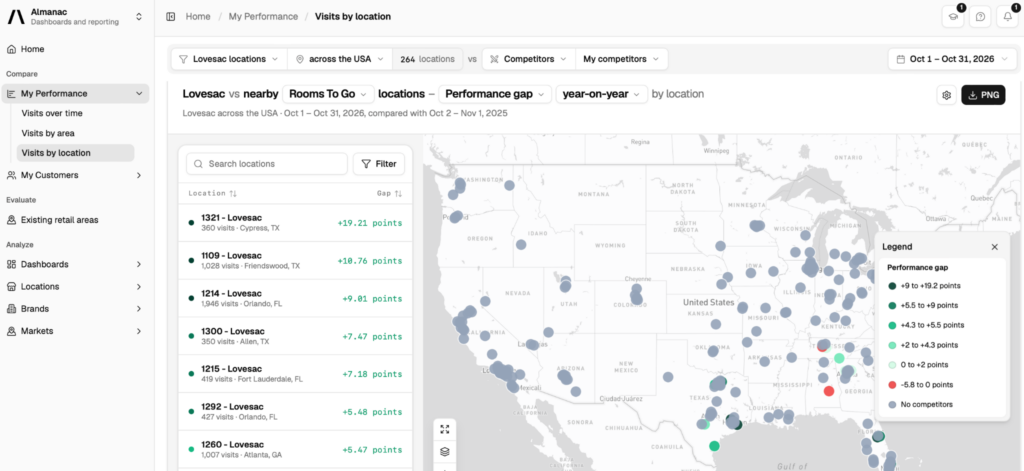
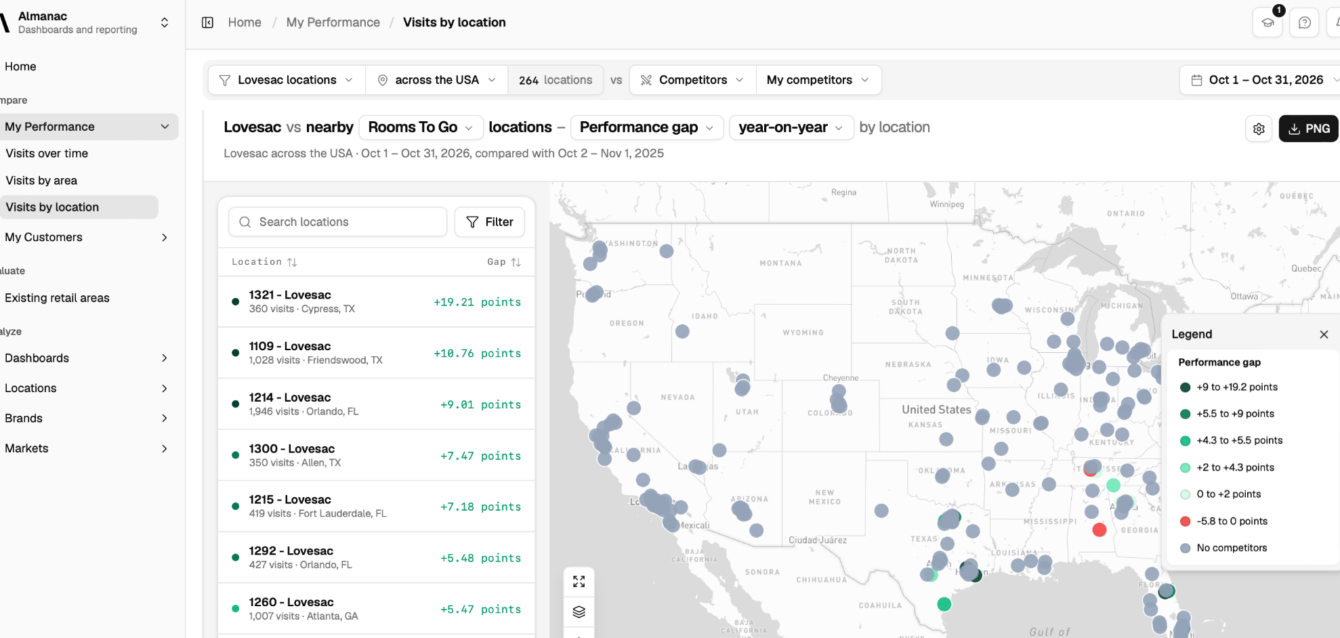
Most retailers we speak to want reliable, easy to access data about how their competitors are performing to understand their market. We’ve made it easy in our platform Almanac.
All you have to do is login, go to the “My Performance” tab and enter your competitors to compare. In the example above we’ve kept it to just the October time period but you can adjust the range, locations, time period, and competitors selected to match your needs.
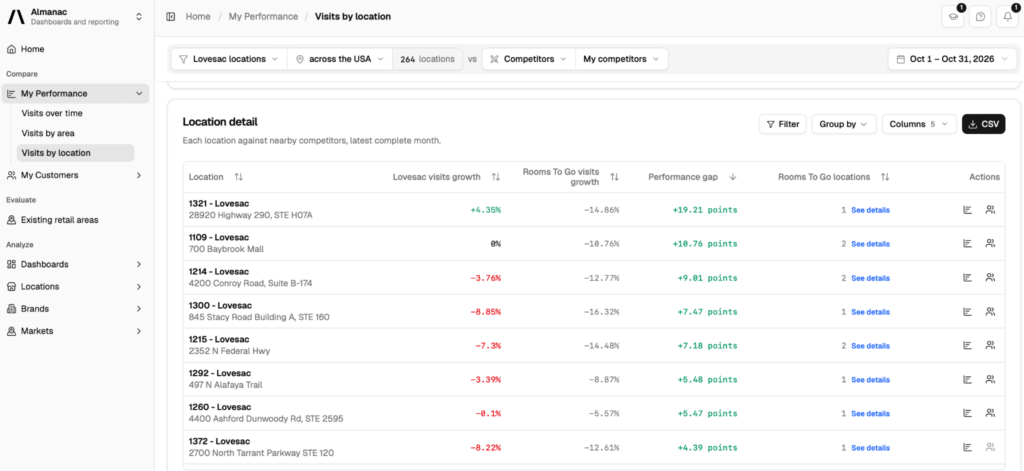
You can even get down to the granular level to compare your store(s) to a nearby competitor. Before and after Black Friday this is an excellent tool for you to quickly see how your store is performing.
Sign up now for a 24-hour free trial of the Almanac platform and see how your brand is performing versus your market.
3. Forecast demand and prepare your inventory
Few things frustrate customers more than discovering that a heavily promoted product is out of stock.
Black Friday can create significant fluctuations in demand, making inventory planning particularly important. Retailers need to balance having enough stock to meet demand without committing too much capital to products that may not sell.
Start by reviewing previous sales data to identify:
- Best-selling products during previous Black Friday events.
- Categories experiencing the strongest seasonal demand.
- Products that regularly sell out.
- Items that generate interest but have lower conversion rates.
- Differences in demand between individual stores and regions.
4. Plan staffing and store operations
More customers can mean more pressure on store teams.
Long queues, overcrowded stores and insufficient staffing can damage the customer experience, even when promotions are attracting plenty of interest.
Retailers should plan staffing levels around anticipated demand, rather than relying solely on standard operating schedules.
Consider:
- Reviewing historical busy periods and peak shopping days.
- Identifying stores that experienced the highest visitor volumes.
- Planning additional staffing for expected busy periods.
- Preparing teams for increased customer enquiries and returns.
- Reviewing checkout capacity and queue management.
- Ensuring store layouts can accommodate higher visitor numbers.
Make smarter decisions this Black Friday with Almanac
Understand your competitors, benchmark store performance and uncover valuable consumer insights with powerful retail foot traffic intelligence through our platform Almanac.
Start your 24-hour free trial and discover what the data can tell you about your market.
5. Create compelling promotions without sacrificing margins
Discounts are central to Black Friday, but competing solely on price can quickly erode profitability.
The challenge is to offer customers genuine value while protecting margins and avoiding unnecessary discounting.
Instead of applying blanket discounts across your entire product range, consider a more targeted approach.
Some strategies include:
- Limited-time offers: Create urgency around selected products or promotional periods.
- Product bundles: Encourage customers to purchase complementary products together.
- Loyalty rewards: Give existing customers exclusive offers or early access.
- Category-specific promotions: Focus discounts on products with strong seasonal demand or excess inventory.
- Cross-selling: Recommend complementary products to increase basket value.
- Exclusive offers: Give customers a reason to choose your brand over competitors.
It’s also important to ensure that advertised discounts represent genuine value. Consumers are increasingly conscious of pricing and are more likely to research products before making a purchase.
DHL’s 2025 Black Friday research found that 71% of surveyed global shoppers said discounts and savings motivated them to spend during the sales period. However, only 50% said they completely or mostly trusted retailers’ offers and prices.
This highlights the importance of transparent pricing and credible promotions.
How PassBy can help: Competitor benchmarking through Almanac can help retailers understand the competitive environment and compare how brands perform across different markets. This provides useful context when deciding where to focus promotional activity.
6. Optimise the in-store shopping experience
Black Friday isn’t just about increasing foot traffic. Retailers also need to make sure those customers enjoy their shopping experience.
Overcrowded aisles, long queues, confusing store layouts and unavailable products can all discourage purchases.
A few improvements can make a significant difference:
- Organise promotional products in easy-to-find locations.
- Make sure pricing and discounts are clearly displayed.
- Ensure popular products are easy to access.
- Provide sufficient checkout capacity.
- Train staff to handle increased customer enquiries.
- Make click-and-collect and collection points easy to navigate.
Retailers should also consider how the shopping experience differs between locations. A busy city-centre store may require different operational arrangements from a destination shopping centre or retail park.
The objective is to make shopping as straightforward as possible, regardless of how many customers visit.
7. Deliver a consistent omnichannel shopping experience
Today’s shoppers don’t necessarily distinguish between online and physical retail.
A customer might discover a product through social media, compare prices online, visit a physical store to see it in person and ultimately purchase through a mobile app.
Black Friday and Cyber Monday make this behaviour even more important.
Retailers should ensure their online and offline channels work together.
Consider implementing:
- Click-and-collect services.
- Consistent pricing across online and physical stores.
- Real-time stock availability on your website, where supported.
- Online promotions that encourage store visits.
- Clear delivery and returns information.
- Retargeting campaigns for customers who browse but don’t purchase.
Cyber Monday is traditionally associated with online shopping, but the distinction between Black Friday and Cyber Monday has become less pronounced as retailers extend promotions across multiple channels.
This means businesses need to consider the entire customer journey rather than treating online and physical retail as separate activities.
8. Monitor foot traffic and understand changing customer behaviour
One of the biggest mistakes retailers can make during Black Friday is relying exclusively on sales figures to understand how their stores are performing.
Sales tell you what customers bought. Foot traffic provides another important piece of the picture: how many people visited in the first place.
Looking at both metrics can help retailers identify opportunities and investigate potential problems.
For example:
- More visits, lower sales: Are visitors struggling to find products, or are conversion rates declining?
- Fewer visits, higher transaction values: Are customers becoming more selective but spending more when they shop?
- Strong traffic growth in certain locations: Could these stores benefit from additional marketing or operational investment?
- Declining visits compared with competitors: Is the brand losing ground in its local market?
This is particularly important during a period when consumer behaviour can change quickly.
RetailNext’s analysis of the 2025 Black Friday weekend found that US in-store foot traffic declined by 5.8% year on year across Friday to Monday. However, average transaction value increased by 2.1% and average unit retail increased by 4.4%.
The findings demonstrate why retailers shouldn’t assume that fewer visitors automatically mean weaker commercial performance.
How PassBy can help: Almanac provides foot traffic intelligence across brands, locations and markets, allowing retailers to analyse visit trends and benchmark performance. Comparing your locations against relevant competitors and market averages can help put changes in customer activity into context. Book a 15 minute demo of Almanac.
9. Measure campaign performance beyond revenue
Once Black Friday and Cyber Monday are underway, retailers need to understand whether their campaigns are delivering the expected results.
Revenue is an important measure, but it doesn’t always explain why performance has changed.
A more comprehensive approach combines sales information with customer and location metrics.For retailers operating multiple locations, comparing these metrics at store level can reveal significant differences.
| Performance metric | What it tells you |
| Total revenue | How much money did the business generate? |
| Store visits | How many people visited physical stores? |
| Foot traffic growth | Are visits increasing or declining year on year? |
| Conversion rate | What proportion of visitors made a purchase? |
| Average transaction value | How much did customers spend per transaction? |
| Revenue per visitor | How effectively is foot traffic generating revenue? |
| Competitor visits | How are competing retailers performing? |
| Visitor demographics | Which consumer groups are visiting your stores? |
A store might generate more revenue because it attracts more visitors, while another might achieve stronger conversion despite lower foot traffic.
Understanding these differences helps retailers identify what is working and where improvements are needed.
10. Understand who is visiting your stores
Attracting more customers is valuable, but understanding who those customers are is equally important.
Black Friday promotions can attract shoppers who wouldn’t normally visit your stores. Understanding whether these visitors match your target audience can help retailers evaluate the effectiveness of their campaigns.
Consider questions such as:
- Are you attracting your usual customer demographic?
- Are younger or older consumers visiting more frequently?
- Are higher-income households represented in your visitor profile?
- Are visitors travelling from further away?
- Which consumer groups are most likely to visit competing brands?
These insights can help retailers refine their marketing strategies and identify opportunities to reach new audiences.
For example, a retailer might discover that a particular store attracts a significantly different consumer profile from the rest of its portfolio. This could indicate an opportunity to tailor promotions and product ranges to local preferences.
11. Identify cross-shopping and competitor opportunities
Understanding where your customers shop beyond your own stores can reveal valuable opportunities.
Cross-shopping analysis looks at the other brands and retailers that visitors to a particular brand or location also visit.
For retailers, this can help answer questions such as:
- Which competing brands attract similar customers?
- What other retailers do our visitors commonly visit?
- Are there complementary brands that attract the same audience?
- Which retailers could offer potential partnership opportunities?
- Are customers visiting competitor locations more frequently?
For example, a footwear retailer might discover that its visitors also commonly visit sportswear retailers, department stores and fashion brands.
This information can help inform co-marketing opportunities, promotional partnerships and competitor analysis.
It can also reveal which brands are competing for the same customer spending, even when they operate in different retail categories.
12. Use Black Friday insights to prepare for Christmas
Black Friday and Cyber Monday shouldn’t be treated as the end of the holiday shopping strategy.
For many retailers, the period provides valuable insight into customer behaviour ahead of the Christmas trading season.
Once the promotional period is over, take time to review the results and identify lessons that can be applied to December.
Look at:
- Which stores experienced the strongest visitor growth?
- Which promotions generated the most interest?
- Which consumer groups responded best to campaigns?
- Did competitor performance change during the period?
- Were there significant differences between markets?
- Which locations might benefit from additional investment?
- How did visitor activity compare with previous years?
Use these findings to refine your Christmas marketing campaigns, adjust store operations and identify opportunities to improve performance.
It’s also worth monitoring foot traffic throughout December rather than focusing solely on Christmas Eve or the final shopping weekend. Different retail categories and locations can experience very different seasonal patterns.
How retailers can prepare and learn from Black Friday
Preparing for Black Friday involves more than understanding your own business. Retailers also need to understand the wider market, their competitors and the consumers they want to attract.
PassBy Almanac brings together retail foot traffic intelligence, market insights and consumer data to help retailers make more informed decisions.
Rather than relying on assumptions about customer behaviour, retailers can use data to understand what’s happening across their markets and identify opportunities to improve performance.
Ready to see what retail foot traffic data can tell you about your business? Start your 24-hour free trial of Almanac and explore the competitor, market and consumer insights that can help you make smarter retail decisions.
Black Friday FAQs
How can retailers prepare for Black Friday?
Retailers should begin preparing several weeks or months in advance. Key steps include analysing previous sales performance, researching competitors, forecasting demand, securing inventory, planning promotions and preparing staff. Understanding historical customer behaviour and foot traffic can also help retailers anticipate demand and allocate resources more effectively.
How can retailers increase sales during Black Friday?
Retailers can increase sales by offering competitive promotions, creating a seamless shopping experience, promoting deals across multiple channels and ensuring popular products are available. Understanding competitor activity and customer preferences can also help retailers create more targeted offers.
What are the biggest challenges retailers face during Black Friday?
Common challenges include increased competition, pressure on profit margins, stock shortages, staffing constraints, website performance issues and managing high customer volumes. Retailers also need to understand whether increased promotional activity is generating genuinely incremental sales.
How can retailers monitor competitor activity during Black Friday?
Retailers can monitor competitor pricing, promotional campaigns, store locations, product availability and customer activity. Foot traffic intelligence can provide additional insight into which competitors are attracting visitors and how their store performance changes during the promotional period.
How can retailers use Black Friday data to prepare for Christmas?
Retailers can analyze Black Friday performance to identify successful promotions, high-performing locations, changing customer demographics and competitor movements. These insights can help inform Christmas marketing strategies, store operations and future trading decisions.