

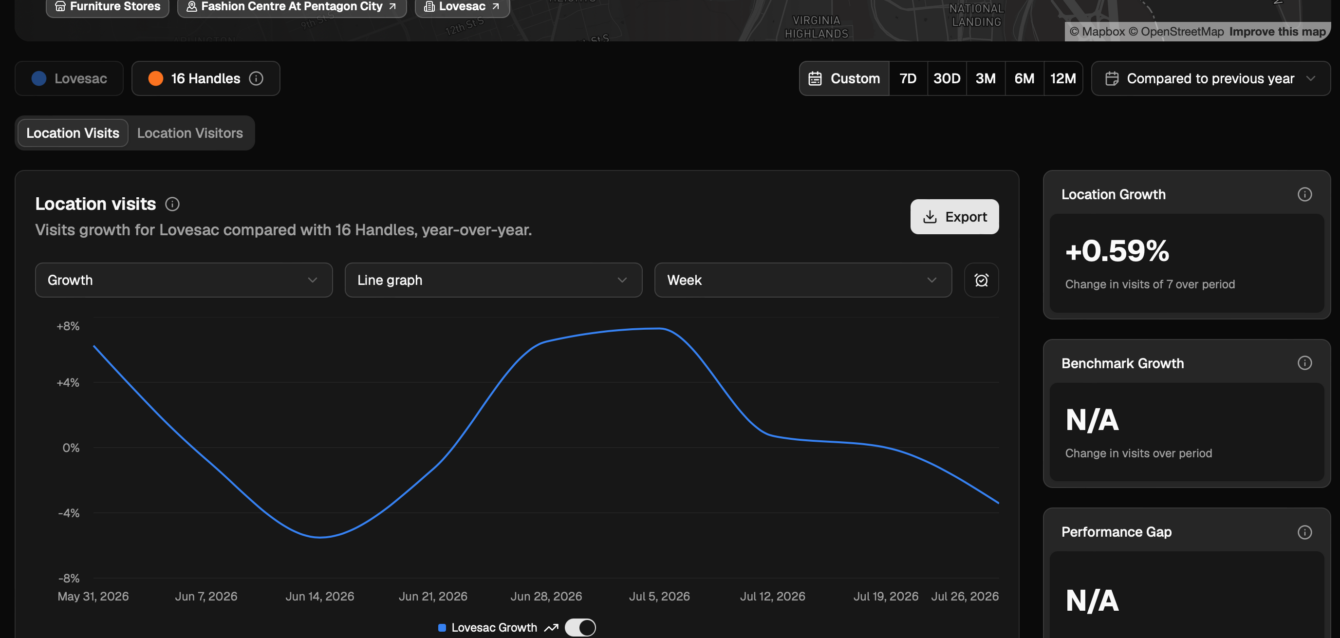
Real-time foot traffic metrics represent the frontier of location intelligence, offering businesses an immediate and dynamic view of consumer movement within the physical world. Unlike traditional historical data, real-time foot traffic provides up-to-the-minute insights into visitor volumes, dwell times, and flow patterns in areas ranging from individual stores and shopping centers to entire urban districts.
Here’s our guide on how to use real-time foot traffic data, how it’s measured, and where to find it.
- Need real-time data? Our Test & Learn trial period provides 60 days of Almanac access to evaluate fit. See pricing →
What Are Real-Time Foot Traffic Metrics
Real-time foot traffic metrics refer to the immediate, up-to-the-minute data collected on the movement and volume of people within a specified physical area, such as a retail store, shopping mall, urban street, or event venue.
Real-Time and Predictive Foot Traffic Providers
The increasing demand for precise and actionable insights into consumer movement has led to the proliferation of specialized foot traffic data providers offering real-time and predictive foot traffic metrics. These companies leverage a variety of advanced technologies and data sources to accurately measure, analyze, and forecast pedestrian flow, providing invaluable intelligence to businesses across numerous sectors.
| Provider | Data coverage | Data Depth | Pricing |
| PassBy | 1.5m+ store locations, 1m+ trade areas | Foot traffic, spend, demographics, psychographics, trade areas, competitive benchmarking, 60-day predictive feeds | 3 tiers: Essential, Premium, Ultimate. Test & Learn (60-day trial) available. See pricing → |
| Placer.ai | Wide US coverage across retail, CRE, dining, entertainment | Foot traffic, demographics, trade areas, competitive benchmarking, migration trends. No spend data | Custom annual contracts. Freemium tier available with limited access. Estimated $12k-$50k/year for paid plans |
| Safegraph (Dewey) | 80m+ POIs globally across 195+ countries | POI database, building footprints, neighbourhood visit patterns. Stronger on POI data than visit analytics | Annual subscriptions based on data volume. Free data samples available |
PassBy Real-Time and Predictive Footfall Data
While many providers offer real-time foot traffic data, none but PassBy offer real-time data alongside predictive analytics in partnership with NeuralProphet, developed by Stanford Ph.D. candidates, to build the most advanced, AI-powered foot-traffic model for retail.
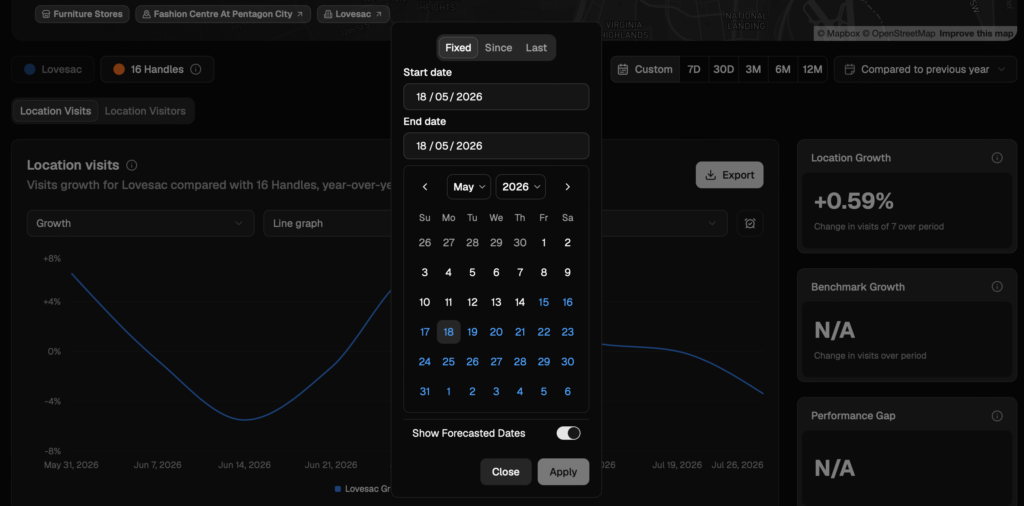
To access real-time and predictive data from PassBy, login to the Almanac platform then select a location you’d like to analyse. Select the “Custom” range to view the predictive data which can span for 60 days.
How is AI used in foot traffic data?
Artificial intelligence (AI) has fundamentally transformed the way businesses collect, analyze, and leverage foot traffic data, making it more accurate, comprehensive, and predictive than ever before. Rather than relying on simple counting methods or periodic surveys, AI enables the continuous, real-time monitoring and sophisticated interpretation of movement patterns.
PassBy uses Artificial Intelligence to refine raw foot traffic data into predictive insights and provide actionable insights for retailers.
Read about our foot traffic data API to find out more.
Key Applications of AI in Foot Traffic Data:
- Object Detection and Tracking:
- Computer Vision: AI algorithms, specifically using deep learning models, analyze video feeds from existing security cameras or dedicated sensors to automatically identify and count individuals. They can differentiate between people and other moving objects (like cars, shopping carts, or pets), vastly improving accuracy over traditional motion sensors.
- Persistent Tracking: Advanced AI systems can track the movement path of an individual or a group (while maintaining privacy by only focusing on movement patterns, not identity) throughout a defined space, offering detailed insights into dwell time, routes taken, and areas of highest engagement.
- Predictive Analytics:
- Forecasting: AI uses historical foot traffic data, combined with external factors such as weather, public holidays, local events, and time of day, to build highly accurate predictive models. These models can forecast future traffic volumes for specific hours, days, or seasons.
- Operational Optimization: Businesses use these forecasts to optimize staffing levels, manage inventory, schedule maintenance, and adjust utility usage, ensuring peak operational efficiency that aligns with anticipated customer flow.
- Anomaly Detection:
- Security and Safety: AI continuously monitors traffic patterns and flags any significant deviations from the norm—sudden surges, blocked pathways, or unusual congregating—which can indicate a safety issue, a potential queue bottleneck, or even security concern.
- System Integrity: It also helps ensure the data’s reliability by flagging sensor malfunctions or data irregularities that need manual review, ensuring the overall dataset remains clean and trustworthy.
- Customer Behavior Segmentation:
- Grouping and Profiling: AI algorithms can group different customer movement patterns into segments (e.g., “Browsers” who spend long periods in various areas vs. “Mission Shoppers” who move directly to a specific point).
- Personalized Experience: This segmentation allows retailers and venue operators to tailor marketing messages, store layouts, and product placements to better serve the dominant or target customer segments identified by the AI.
- Multi-Source Data Integration:
- AI excels at integrating data streams from diverse sources—including Wi-Fi triangulation, Bluetooth beacons, mobile app location data (when permission is granted), and computer vision feeds—to create a unified, holistic view of foot traffic. This triangulation eliminates blind spots and provides a more comprehensive understanding of the customer journey both inside and outside the physical location.
Key Types of Providers
- Mobile Location Data Aggregators: These providers collect anonymized location data from millions of mobile devices via apps, operating systems, and other third-party data streams. They specialize in transforming raw latitude and longitude coordinates into meaningful foot traffic metrics, such as unique visitors, dwell time, and trade area analysis for specific Points of Interest (POIs). Their strength lies in their broad geographic coverage and ability to track movement patterns over time.
- Wi-Fi and Bluetooth Sensor Networks: Often deployed within physical retail locations, shopping centers, or smart cities, these systems use specialized hardware (sensors, access points) to detect the presence of nearby mobile devices via Wi-Fi probing or Bluetooth signals. These metrics are highly accurate for in-store or venue-specific analysis, helping businesses understand conversion rates, store layout effectiveness, and queue times.
- Satellite and Aerial Imagery Analysts: A less common but growing category, these providers use high-resolution satellite, drone, or aerial imagery combined with advanced computer vision and machine learning algorithms to count and track vehicles and people within large outdoor spaces, such as parking lots, open-air venues, or construction sites. This method is valuable for large-scale trend analysis and measuring the immediate impact of major events.
- Integrated Geo-Analytics Platforms: These platforms often combine data from multiple sources (mobile, sensor, demographic data) and overlay them with sophisticated modeling to offer both historical foot traffic data and predictive analytics. They provide comprehensive dashboards and APIs that allow businesses to integrate foot traffic insights directly into their operational and marketing strategies.
Core Services Offered by Real-Time Foot Traffic Data Providers
The services provided by these foot traffic data vendors typically include:
- Real-Time Monitoring: Providing live or near-real-time updates on visitor counts and flow patterns, crucial for immediate operational adjustments (e.g., staffing, security).
- Historical Analysis: Delivering aggregated data over time (daily, weekly, monthly) to identify long-term trends, seasonality, and the performance impact of marketing campaigns or external factors.
- Competitive Benchmarking: Allowing businesses to compare their own foot traffic performance against nearby competitors or industry averages.
- Site Selection and Optimization: Helping retailers, developers, and real estate professionals evaluate the viability of potential new locations based on current and projected foot traffic.
- Predictive Modeling: Using historical data, demographic factors, and machine learning to forecast future visitor volumes, aiding in inventory management, labor scheduling, and financial planning.
By leveraging the insights from these specialized providers, businesses gain a significant competitive edge, moving beyond simple sales data to understand the “why” and “when” behind consumer behavior in the physical world.
Key Characteristics of Real-Time Metrics
- Immediacy: The data is collected, processed, and made available with minimal delay (often in seconds or minutes), allowing businesses to respond instantly to current conditions.
- Dynamic Measurement: Measuring foot traffic means monitoring the continuous flow of people, providing a live snapshot rather than an aggregated historical view.
- Actionable Insights: This immediate data is critical for making time-sensitive operational decisions, such as adjusting staffing levels, optimizing store layouts during peak hours, or triggering dynamic digital signage based on crowd size.
Types of Real-Time Foot Traffic Metrics
| Metric | Description | Application |
|---|---|---|
| Current Occupancy/Count | The exact number of people inside a defined area at a given moment. | Capacity management, safety compliance, immediate staffing needs. |
| Live Flow/Entry & Exit Rate | The number of people entering or exiting the area per minute or per hour. | Identifying sudden spikes or drops in traffic, managing queues. |
| Real-Time Dwell Time | The current average or specific time individuals are spending in a particular zone or store. | Assessing engagement with promotions or displays as they happen. |
| Live Heatmaps | Visual representation of where people are congregating or moving within the space right now. | Identifying immediate bottlenecks or newly popular areas for merchandising adjustment. |
| Passing Traffic Rate | The number of people passing by a storefront or zone who don’t enter, measured live. | Real-time effectiveness check of window displays or sidewalk promotions. |
Technologies Used for Real-Time Foot Traffic Tracking
Real-time foot traffic metrics are typically collected using a combination of technologies:
- Wi-Fi and Bluetooth Sensors: Detect and track mobile devices (anonymously) as they move through a location.
- Computer Vision (Camera-based Systems): Use video footage and AI to count people, track movement, and calculate dwell time instantly.
- Infrared and Thermal Counters: Devices placed above doorways to provide accurate, directional counts of entries and exits in real-time.
- Geospatial Data (Location Intelligence): Leveraging aggregated, anonymized GPS data from mobile apps to measure current footfall in broader urban areas or near competitor locations.
Do retailers use real time foot traffic metrics?
Yes, retailers are increasingly relying on real-time foot traffic metrics. Retailers from shopping malls to national retailers use real-time foot traffic data and foot traffic predictive data for operational efficiency, immediate decision-making, and to enhance the customer experience.
Retailers use real-time footfall data to:
- Immediate Operational Adjustments:
- Staffing Optimization: When real-time metrics show an unexpected spike in customer entry rates, managers can immediately deploy more staff to the sales floor, checkout lanes, or fitting rooms to reduce wait times and prevent lost sales.
- Inventory Replenishment: Live heatmaps showing high congestion around a specific display can trigger an immediate alert to restock that area, ensuring popular items are always available.
- Conversion and Performance Monitoring:
- Live Conversion Rates: By comparing real-time entry counts to point-of-sale data, retailers can calculate a live conversion rate, allowing them to quickly assess the effectiveness of a new promotion or window display as it is running.
- Marketing Responsiveness: If the passing traffic rate is high but the entry rate is low, retailers can immediately change a digital sign or a window promotion to draw people inside.
- Safety and Compliance:
- Capacity Management: Real-time occupancy counters are critical for retailers to adhere to safety regulations, especially in limited-capacity venues, ensuring the store does not become overcrowded.
- Customer Experience Enhancement:
- Queue Management: Live flow data allows managers to open or close checkout lanes instantly based on queue length and customer waiting times, improving the shopping experience.
In short, for modern retailers, real-time foot traffic metrics have moved from a “nice-to-have” tool to a critical operational necessity for maximizing sales and minimizing operational friction.
Conclusion: The Future of Physical Retail is Real-Time
Real-time foot traffic metrics are no longer a specialized tool but a foundational element of modern business strategy, particularly for physical retail and commercial real estate. By offering immediate, dynamic, and actionable insights into consumer movement, these metrics enable businesses to shift from reactive analysis to proactive, minute-by-minute decision-making.
From optimizing staffing levels based on a sudden rush of customers to instantly adjusting merchandising displays in response to live heatmaps, the power of real-time data is its capacity to drive operational efficiency and enhance the customer experience as it happens. As technology continues to evolve—integrating predictive AI, advanced computer vision, and granular mobile location data—the competitive gap between businesses that utilize real-time insights and those that rely solely on historical data will only widen.
The future of physical commerce is one where every business decision is informed by the live pulse of pedestrian activity, ensuring maximum sales conversion, minimized operational friction, and a genuinely optimized physical footprint.
Need real-time data? Our Test & Learn tier provides 60 days of Almanac access to evaluate fit. See pricing →