

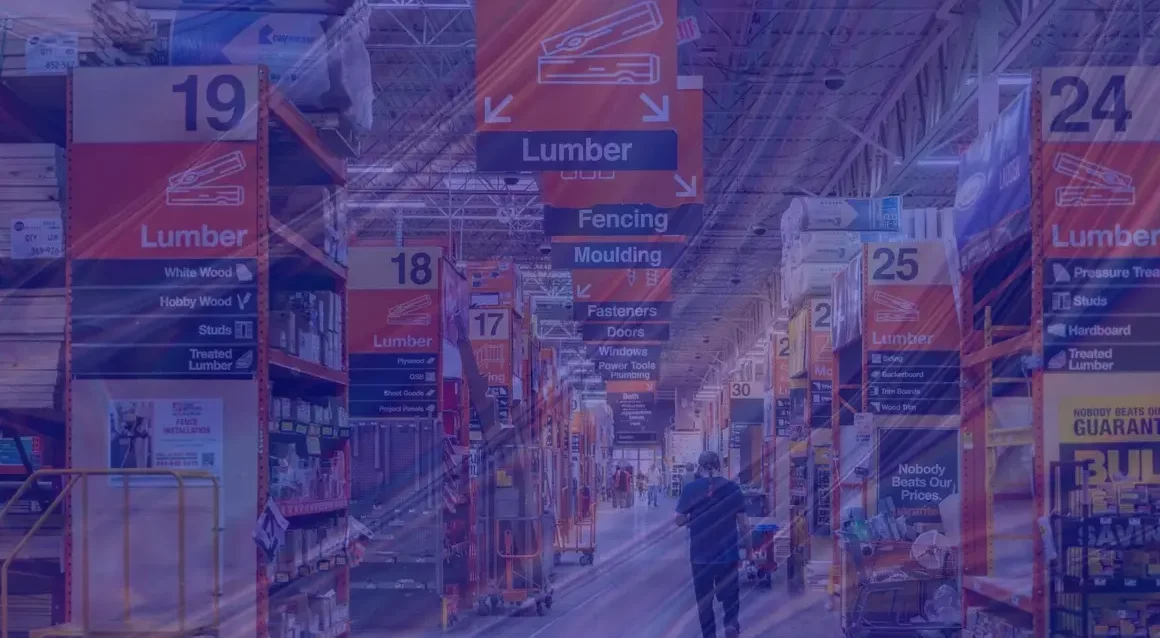
Currently, Home Depot has 51% of the home improvement retail market share, while Lowe’s has 28.8% and Menards has 4.6%. These top three home improvement retailers all have unique strategies to reach their customers. We’ll be looking at how these retailers have been performing and offering insights into the market using years of historical foot traffic data and AI-powered insights.
To see how well your brand and competitors are performing, book a call to get a demo.
Jump to:
Home improvement retailers built a strong start in Q1 2026
- Home Depot is stable year-on-year in Q1 2026 (-0.08%), signaling that traffic has finally normalized to a sustainable baseline.
- Lowe’s is the only major home improvement retailer to have significant positive momentum heading into the spring of 2026, boasting a +2.5% YoY growth in early 2026
- Smaller hardware brands such as True Value and Harbor Freight have seen an uptick in visits and market share, quietly sustaining a comfortable corner in the market.
Following several years of post-pandemic setbacks—highlighted by Home Depot’s traffic decline of 4.3% in 2023 and nearly 2% in 2025—the downward trend has finally come to a halt. Home Depot’s visits are effectively unchanged year-over-year in Q1 2026, with a minor dip of 0.08%, indicating that foot traffic has now reached a sustainable level.
In addition to Home Depot’s stabilization, Lowe’s is emerging as the leading major home improvement retailer with substantial positive momentum as we approach the spring of 2026. Lowe’s have recorded a 2.5% growth in year-over-year visits in early 2026, marking a remarkable turnaround after experiencing deeper declines than Home Depot in both 2024 and 2025.
True Value, on the other hand, has made an unexpected comeback. After enduring a challenging 2025 with a 6.2% drop in foot traffic, True Value has successfully bounced back with a 3.1% increase in the early months of 2026.
Meanwhile, Harbor Freight has stealthily increased its market share. Back in 2021, they held 13.7% of this competitive market, and today, that number has risen to 14.7%. With an impressive 11.4% surge in foot traffic in 2023, they have maintained these gains and positioned themselves distinctly ahead of smaller neighborhood hardware brands.
To see how well your brand and competitors are performing, book a call to get a demo.
Home Depot vs Lowe’s
- Overall, Home Depot recieves more visits every year than Lowe’s. But Home Depot has far more stores. The two retailers are each other’s main competition and our data shows the remarkable similarities along with the stark differences on how these home improvement giants operate.
- Home Depot is stable year-on-year in Q1 2026 (-0.08%), signaling that traffic has finally normalized to a sustainable baseline.
- Lowe’s is the only major home improvement retailer to have significant positive momentum heading into the spring of 2026, boasting a +2.5% YoY growth in early 2026
Market share comparison
- Home Depot has a larger average market share, but both brands are projected to lose market share points.
- In 2021, Home Depot’s average market share across states was higher at 26.81% compared to Lowe’s at 22.97%.
- The projection for 2025 maintains this gap, with Home Depot at an average of 24.95% and Lowe’s at 21.15%.
- Both brands are projected to lose a similar magnitude of average market share points between 2021 and 2025.
- Lowe’s is projected to slightly outperform Home Depot in stemming market share point loss.
- Home Depot’s average market share is projected to decrease by 1.86points.
- Lowe’s average market share is projected to decrease by a slightly smaller amount, at 1.82 points.
- This suggests that, on average across the sampled states, Lowe’s is performing marginally better at retaining its market share compared to Home Depot.
Weekend visits
- The average weekend traffic percentage for Lowe’s is 29.36%.
- The average weekend traffic percentage for Home Depot is 29.13%.
- The difference between the two retailers is insignificant and shows similar customer behavior.
- Both brands show a trend of slightly increasing weekend traffic as a percentage of total visits over the period, with Lowe’s peaking at nearly 30% in 2025 and Home Depot peaking at 29.51% in 2025.
To see how well your brand and competitors are performing, book a call to get a demo.
Home improvement store expansion and optimization
The landscape of physical store expansion has seen significant shifts over the years. Ace Hardware has shown impressive growth in stores, adding 886 new locations in the past five years—representing a remarkable 22.8% increase. Similarly, Do It Best has expanded by 580 locations, achieving a 21.6% growth rate. This sweeping expansion, however, highlights a reliance on increasing their physical presence rather than enhancing per-store sales performance, as their traffic sees slight declines.
Conversely, giants like Home Depot and Lowe’s have opted for a more conservative approach, virtually pausing their expansion strategies. Lowe’s added a modest 29 stores, reflecting a 1.6% increase, while Home Depot grew by just 19 stores, a 0.9% increase. Both continue to compete within their existing footprints, focusing on internal store optimizations.
On the flip side, True Value has reduced its store count by 277, a significant 12.5% decrease. Nonetheless, they have managed to achieve a commendable 3.1% uptick in traffic within Q1 2026, drawing more customers to their now more concentrated network of stores.
Seasonal home improvement retail trends
In the world of home improvement retail, May is the undisputed heavyweight champion. While the winter doldrums keep stores quiet—with January and February seeing a low of 6.4% to 6.8% of annual foot traffic—May sees a massive surge.
Accounting for 9.7% of yearly visits, May’s foot traffic is nearly 50% higher than February’s.
Big Box vs. The Neighborhood Local
While the giant retailers see a sharp spike, local favorites like Ace Hardware and True Value experience a slightly different rhythm:
- The Spring Plateau: Instead of one sharp peak, local shops enjoy sustained high traffic across both May and June.
- The “Lawn & Leaf” Effect: This trend suggests that while we might hit the big-box stores for a massive lumber haul, we visit our neighborhood hardware stores more frequently for the “maintenance phase”—grabbing soil, mulch, and gardening tools throughout the season.
Whether it’s a major renovation or just keeping the hydrangeas alive, the data proves that when the sun comes out, the DIYers come out to play.
Regional battlegrounds: the changing map of home improvement
The home improvement landscape is undergoing a massive geographic shift. While the industry giants once seemed untouchable, the data from 2021 to 2025 reveals a “Big Box retreat” in rural America, making room for agile regional players to seize significant territory.
1. The Big Box Retreat in Rural America
The dominance of Home Depot and Lowe’s is fading in less densely populated regions. In northern and rural states, these giants are bleeding market share as consumer preferences shift toward more accessible or specialized local options.
- Key Losses: Home Depot has seen a decline of 3 to 5 points in market share across states like Minnesota, Montana, Wyoming, and the Dakotas.
2. Do It Best Conquers the North
While the big players pull back, Do It Best is staging a total territorial takeover. Their growth isn’t just incremental; it’s explosive. By capitalizing on the vacuum left by Big Box retailers, they have become the new powerhouse of the North.
- North Dakota: +22.6 points
- Montana: +14.9 points
- Minnesota: +14.5 points
3. Harbor Freight Wins the South & Mid-Atlantic
In the South and along the Mid-Atlantic ridge, Harbor Freight is the aggressor. Their model of consistent, targeted expansion has led to steady market share gains in key states:
- Mississippi: +5.4 points
- Delaware: +5.2 points
- Significant Growth: West Virginia and Louisiana.
The Pro vs. DIY split: weekday hustle vs weekend-projects
Understanding when customers shop is just as important as where they shop. The data from 2021 to 2025 reveals a clear divide between the professional contractor and the casual weekend warrior.
1. The DIYer is Making a Comeback
After a few years of fluctuating habits, the “weekend project” is officially trending upward. Across almost every major brand, the percentage of foot traffic occurring on Saturdays and Sundays has seen a slow but steady climb.
- Home Depot: Weekend share grew from 28.5% to 29.5%.
- Lowe’s: Experienced a more significant jump, rising from 28.6% to nearly 30%.
- The Takeaway: This shift suggests that the “Do-It-Yourself” spirit is reclaiming its place in the retail calendar.
2. Do It Best: The “Pro” Heavyweight
You might expect the “Big Box” giants to own the professional market, but the data tells a different story. Do It Best has emerged as a massive “Pro” hub, with a footprint heavily geared toward the work week.
- Weekday Dominance: While Home Depot and Lowe’s hover around 70% weekday traffic, Do It Best sits at a staggering 75%.
- The Contractor Connection: This high weekday concentration indicates that their locations are primary destinations for local contractors and tradespeople rather than casual Saturday morning shoppers.
3. Menard’s: The Weekend Destination
While others fight for the professional crowd, Menard’s has successfully captured the “Saturday family shopping trip.” Their weekend numbers consistently outperform the competition, hovering between 29.3% and 30.1%.
- The “One-Stop Shop” Edge: Unlike its competitors, Menard’s carries a much broader inventory, including groceries and household goods.
- The Family Draw: This variety turns a trip for hardware into a full household errand, naturally driving higher traffic during the weekend.
Building a resilient strategy: final thoughts
The home improvement retail sector has consistently demonstrated resilience and adaptability, as evidenced by leading players like Home Depot and Lowe’s. Despite facing challenges such as supply chain interruptions and capital limitations for smaller businesses, these giants have managed to optimize store operations and expand strategically.
As you continue to observe trends in this space, be attentive to how these retailers not only respond to but also shape the market landscape, especially through their focus on seasonal peaks and consumer-centric strategies.
To see how well your brand and competitors are performing, book a call to get a demo.